The LinF Specification
L-Systems are formal string rewriting systems introduced in 1968 by the
botanist Aristid Lindenmayer that are used to model fractal images. LinF
allows the definition of L-Systems that represent three-dimensional fractals
and stochastic fractals.
LinF is a simple language used to describe 3D L-Systems to be interpreted
according to the turtle method. A program in LinF is formed by six blocks, none
of which are mandatory although it is not possible to generate fractals if some
of them are missing. These six blocks are called angles,
lines, blanks, axiom, rules and
colors. There is no order in which the blocks should appear in a LinF
program. A short description of each block is given next:
- [axiom] Defines the axiom of the L-System. An axiom is the
starting point from which the fractal will be generated.
- [lines] Defines which symbols will represent lines in the production
rules. When evaluating the production rules, the lines should be drawn.
- [blanks] Defines which symbols will represent blanks or transparent
lines in the context of a particular LinF program.
- [angles] In this section we define the rotation angles that can
appear in the fractal description. A rotation angle is constituted by two
elements. The first component of a rotation specifies the angle of
torsion and the second one specifies the curvature.
- [rules] This module of a LinF program describes every production rule
that forms the fractal. A production rule is formed by two parts: the left
side and the right side. The left side is simply an identifier while the
right side is an arbitrary sequence of expressions. As in Chomsky formalism,
the grammar rules in LinF are constituted by terminal and
non-terminal symbols. Every symbol that appears in the left side of a
production rule is considered a non-terminal symbol. Some of the non-terminal
symbols do not have any meaning for the fractal representation and are used
just to facilitate the grammar specification.
- [colors] In this section the fractal designer can specify a list of
colors that will be used to draw the fractal. The list will be stored in
order of specification within the LinF file. The first lines of the
fractal will have the first color in the list. When the { symbol is
encountered in the fractal string, the next color becomes the current one.
If the symbol } is encountered, the previous color becomes active again. If
a number of { exceeding the number of colors stored in the color list is
found, then the last color recorded becomes the current color.
The LinF Interpreter
Before understanding how fractals are represented with the LinF formalism, it
is worthwhile to comprehend the nature of a basic LinF interpreter. The LinF
interpreter is a program that generates fractal figures based on the LinF
description of the fractal structure. In this section will be described the
structure of cFleo, a simple LinF interpreter developed in C,
whose schematic view can be seem below:
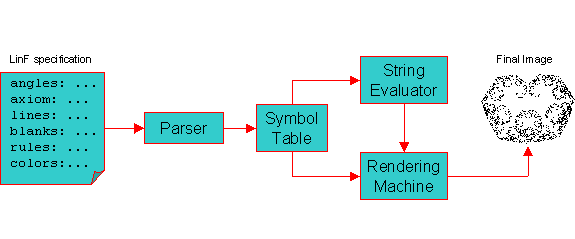
The LinF interpreter can be divided into three main constituents:
the parser, the evaluator and the rendering machine.
The parser is responsible for recognizing the correctness of a LinF file and
retrieving from it the meaning of the user-defined symbols, for instance, the
name of lines, blanks and angles.
The next component of cFleo is the evaluator. This program is responsible for
applying the production rules over the axiom of the fractal and then over the
successive strings obtained by the application of the rules. A production rule
is formed by two parts. The left side symbol and the right side sequence of
symbols. To apply a rule over a string traditionally means to substitute every
occurrence of its left side that appears on the string for its right side.
In addition to the simple scheme for defining rules, LinF permits the bounding
of some rules to a probabilistic chance of occurrence. This means that during
the string evaluation, some symbols which are the left side of a production
rule may not be expanded. This pattern of evaluation allows the creation of
stochastic L-Systems that are useful to model real entities such as rivers and
plants.
The last constituent of cFleo is called the rendering machine. The rendering
machine is responsible for displaying the fractal that is represented by a
string. In order to implement this part of cFleo, it was used the OpenGL
library. This machine has always a state that is represented by the
tuple (position, frame, length, color). During the rendering process, the state
is continuously being updated while the segments that constitutes the fractal
are being drawn according to the state elements. The meaning of each one of the
four state elements is described below:
- [position] This element specifies a point in 3D space. The next line to
be drawn will be displayed as a segment starting at this point.
- [frame] This element is composed by a set of three orthonormal
vectors t,n,b, whose meaning is explained
here. The
next line to be drawn will be exhibited in the direction of t.
- [length] This element defines the length of the next segment to be drawn.
- [color] This element specifies the color of the next segment to be drawn.
The LinF interpreter keeps processing the fractal string in a circular fashion
in which firstly the string is expanded by the evaluator and next it is read by
the rendering machine, which uses it to display a graphical representation of
the fractal in a window. The string that represents a fractal contains symbols
that force updates into the rendering machine state during the evaluation
process. The semantics of each such symbol is explained in the next section.
Representation of Fractals in LinF
LinF, as an L-System-based formalism, allows fractals to be described by
strings that contain finite sequences of symbols. These symbols can be
terminals, non-terminals, numbers and reserved words of LinF. LinF has
nine reserved symbols that are explained below:
- [: Saves the current machine state in a stack.
- ]: Restores the machine state to the state stored in the top
of the stack and pops the stack.
- @: Multiplies the current line length by the number previously seen.
This symbol is always preceded by a floating point number that specifies the
amount used to multiply the current length.
- ?: This symbol does not have any utility during the drawing process. It
is useful only during the process of rule application. It means that the next
symbol has a chance of not being expanded by the rule in which it appears on
the left side. It should always be preceded by a floating point number in the
interval (0,1), which specifies the probability of expansion.
- +: Updates the state with a rotation given by an angle specified. This
angle will be given by the identifier that follows a sequence of +
signs. Note that more than a + sign can be encountered together. It is
possible to declare a default rotation in the angle section. In this case, if a
sequence of + is not followed by any angle identifier, the default
rotation must be assumed.
- -: This symbol has the same meaning of
- +
, except that it causes a
rotation by minus the specified angle.
- {: This symbol forces a change in the color state. When a {
is found, the current color is replaced by the next color in the list of
colors. If the current color is already the last element of the list,
then no modification is carried on.
- }: This symbol restores the color state to the previous color.
- !: This symbol causes an inversion in the interpretation of the symbos
+ and -.
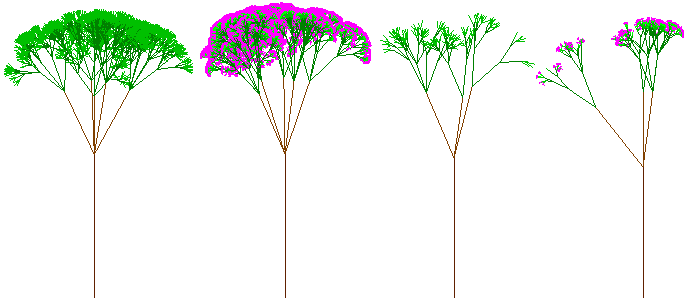
Example
angles
  a: (.0, [.1 .. .7])
  b: ([((pi/3) - 0.3) .. ((pi/3) + 0.3)], .0)
  c: (.0, [.1 .. .6])
  d: (.0, pi)

lines f

axiom 2.0@ f

rules
  f = 0.5 @ g v;
  v = { u + b u + b u + b u + b u + b u};
  u = 0.5 ? t;
  t = [+a f];
  j = + c

colors
	0: (4, 4, 2)
	1: (90, 90, 46)
	2: (156, 156, 78)
	3: (188, 188, 120)
	4: (209, 209, 163)
|
 |