FLAT
Federated Lightweight Authentication of Things
keywords
Authentication, Federated Identity Management, Internet of Things.
Papers
FLAT: Federated lightweight authentication for the Internet of Things. Maria L.B.A. Santos, Jéssica C. Carneiro, Antônio M.R. Franco, Fernando A. Teixeira, Marco A.A. Henriques, Leonardo B. Oliveira. Ad Hoc Networks, Elsevier, 2020.
Federated Identity Management schemes (FIdMs) are of great help for traditional systems as they improve user authentication and privacy. In this paper, we claim that traditional FIdMs are mostly cumbersome and then ill-suited for IoT. As a solution to this problem, we came up with Federated Lightweight Au- thentication of Things (FLAT), namely a federated identity authentication protocol exclusively tailored to IoT. FLAT replaces weighty protocols and public-key cryptographic primitives used in traditional FIdMs by lighter ones, like symmetric cryptographic primitives and Implicit Certificates. Our results show that FLAT can reduce the data exchange overhead by around 31% when compared to a baseline solution. Also, the FLAT Client, the role played by an IoT device in the protocol, is more efficient than the baseline Client in terms of data exchange, storage, memory, and computation time. Our results indicate that FLAT runs efficiently, even on top of resource-constrained devices like Arduino.
Visit Paper (2020)Federated Authentication of Things: demo abstract. Maria L. B. A. Santos, Jéssica C. Carneiro, Fernando A. Teixeira, Antônio M. R. Franco, Marco A. A. Henriques, Leonardo B. Oliveira. Proceedings of the 17th ACM/ IEEE International Conference on Information Processing in Sensor Networks (IPSN'18). Demo session. Porto, Portugal, April 2018.
The expansion of the Internet of Things (IoT) creates a great challenge regarding the authentication of devices, especially when one considers the restriction of computational resources and the potential mobility of these devices between different authentication domains. FLAT, is a federated authentication protocol exclusively tailored for IoT. FLAT is applied to real scenarios: an automatic parking system and a cashless toll gate system. The use of only symmetric cryptographic primitives in the Client device and implicit certificates make FLAT a lightweight solution to the IoT environment.
Visit Paper (2018)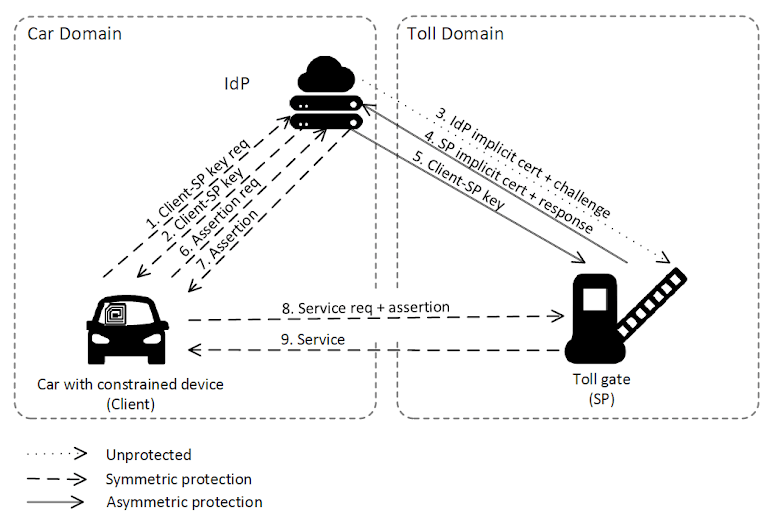
Authentication Protocol Overview
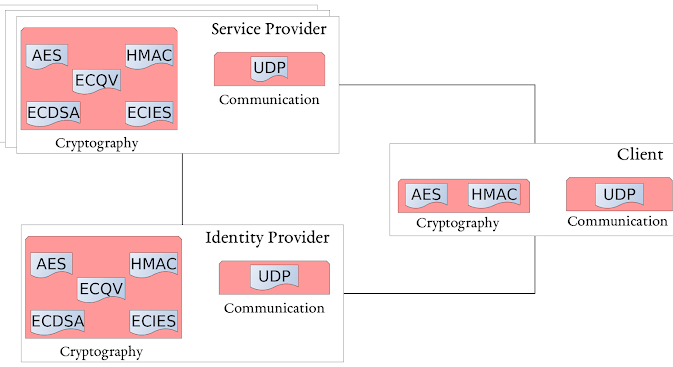
FLAT Architecture
BibTeX
@article{santos2020flat,
  title={{FLAT: Federated lightweight authentication for the Internet of Things}},
  author={Santos, Maria LBA and Carneiro, J{\'e}ssica C and Franco, Ant{\^o}nio MR and Teixeira, Fernando A and Henriques, Marco AA and Oliveira, Leonardo B},
  journal={Ad Hoc Networks},
  volume={107},
  pages={102253},
  year={2020},
  publisher={Elsevier},
  issn = "1570-8705",
  url = "http://www.sciencedirect.com/science/article/pii/S1570870520302468",
  doi = "https://doi.org/10.1016/j.adhoc.2020.102253"
}

@inproceedings{santos2018federated,
  title={Federated authentication of things: demo abstract},
  author={Santos, Maria LBA and Carneiro, J{\'e}ssica C and Teixeira, Fernando A and Franco, Ant{\^o}nio MR and Henriques, Marco AA and Oliveira, Leonardo B},
  booktitle={Proceedings of the 17th ACM/IEEE International Conference on Information Processing in Sensor Networks},
  pages={136--137},
  year={2018},
  organization={IEEE Press}
}