


|
Seven Strategic Moves Towards the Information Society: The Perspective of a Developing
Country
RT.DCC 014/99 |
Ivan Moura Campos
Regina Helena Bastos Cabral
MÊS abril
ANO 1999
Seven Strategic Moves Towards the Information Society:
The Perspective of a Developing Country
Dr. Ivan Moura Campos
ivanmc@akwan.com.br
Dra. Regina Helena Bastos Cabral
Computer Science Department - Federal University of Minas Gerais - Brazil
reginah@dcc.ufmg.br
Resumo:
Este relatório focaliza tecnologias da informação e policymaking em países em desenvolvimento. São abordadas especificamente as questões políticas relativas à experiência dos autores no Governo Federal, especialmente no que se refere a serviços internet, na expectativa de que os resultados obtidos e as lições aprendidas possam ser generalizáveis por outros países em desenvolvimento. Este trabalho foi apresentado pelo primeiro autor no Second Al Shaam Conference on Information Technology, em Damascus, Syria, April 26-29, 1999, como convidado especial pelo World Bank.
Abstract
This presentation focusses on information technologies and policymaking
in developing countries. It draws heavily from our recent government experience
as Secretary for Information Technology in Brazil, especially regarding
Internet services, hoping that both the results obtained and the lessons
learned can be generalized to some extent.
The net result at that time, 1995, was that the penetration of the Internet in businesses and in industry was negligible, the universities were taking care of their own affairs with whichever means they were given, and the TelCos had the dream that this market was theirs because, after all, they had the monopoly, didn´t they?
Seven strategic moves were made, resulting in an agreement between the Ministry of Science and Technology and the Ministry of Communications, effective in May of 1995:
Move #1 - To declare the Internet an information service, and therefore free for all of society to provide and to access.
First, a matter of concept and vocabulary. Whenever people talk about networks, it is important to distinguish three layers: the inner layer encompasses the telecommunications infrastructure, with satellites, antennas, fiber optics cables, and the like. The middle layer consists of the services that can be conveyed by that infrastructure. The Internet is one among them. The third, or outer, layer consists of the applications that can be delivered by making use of the available services. Distance education is one example application that can make use of the Internet service. Some constitutions provide a basis for the original argument: information cannot be subject to monopoly. Once the telecommunications infrastructure is seen as separate from the services layer, one can break the monopoly at the services layer without having to scare the hell out of the telecommunications establishment and without breaking the law.
Move #2- Everyone can provide retail (dial-up) service to the end-user, except TelCos and Government in general.
The rationale behind this strategic move is simple: if the objective
is to generate new jobs and new businesses, like internet service providers,
it does not make much sense to try to convince an entrepreneur that he/she
will have to compete with the company from whom they will have to lease
the basic means, that is, the telecommunications lines. Phone companies
can be information providers and can offer IP connectivity with dedicated
leased lines, but no dial-up Internet services. It is worth
noticing that these services are by far the most laborious to provide and,
according to recent survey, represents less than 0.4 percent of the total
revenues of two major U.S. carriers.
Move #3 - The university-operated backbone was upgraded to include 2 Mb/s lines and to connect all state capitals. Besides, its original academic mandate was extended to allow both commercial connectivity and traffic.
This move had to do with facing the fact that there was not enough Internet culture in the private sector to deploy and operate a nationwide backbone, at that time. It was then decided that the academic backbone would be used to help spread the word. This was seen as an investment, not subsidy.
Brazilian National Research Network Backbone
Move #4 - Creation of an Internet Steering Committee, with representatives from government and the private sector.
Besides the need to foster the development of internet services, a few down-to-earth, practical questions had to be addressed, such as registration of domain names and assignment of IP addresses, and several technical issues such as security practices and recommendations against hackers, network engineering and traffic measurements for improved dynamic routing, etc.
A nine-member Internet Steering Committee was created, with 4 representatives
from government (Ministry for Science and Technology, Ministry of Communications,
National Research Council and Telebras, the state-controlled holding of
the telephone companies) and five from the private sector (a network specialist,
academic community, service providers, user community and equipment manufacturers),
all of them with two-year mandates. It is interesting to remember that
the first meetings of the committee received wide press coverage, and there
were quite a few heated debates about pricing (wether or not they should
be regulated or market-driven), what should be done when there was dispute
over the registration of a domain name, what legal framework should regulate
the matter, etc. In retrospective, those were the pioneer days, and the
fact that the media gave it enormous attention also contributed to make
the common citizen (that is, a non-techie) aware of the existence
of the internet, its applications and entrepreneurial possibilities.
Move #5 - As part of the same agreement, Government issued a Decree whereby all TelCos had to give a 50% discount on the tariff for leased, dedicated lines connecting non-profit educational institutions at all levels.
This move was made in order to help give universal access
to these technologies, while giving a boost to the usually meager budget
of schools. The loss of income for TelCos is absolutely negligible, if
at all: one must remember that in monopolistic situations cross-subsidizing
among services is quite frequent, and tariffs can be fairly arbitrary,
not necessarily reflecting real costs.
Move #6 - Creation of tax incentives for local companies to invest in R&D and in priority programs.
Before all these moves, Brazilian Law 8.248 had established, since 1993, the basic rules for tax incentives to boost local manufacturing of information technology equipment. Basically, in order for a product to be exempt from the value-added tax (VAT, 15%), the manufacturer has to abide by three rules, namely;
What happened since then? In January 1999, Brazil ranked as 17th in
the world in number of Internet hosts, according to Network Wizards.
The number of Internet hosts grew from 17,429 in January 1996 to 215,086
hosts in January 1999. The number of individual users grew from an estimated
250.000 in 1995 (all academic) to around 2.200.000 at the end of 1998.
The commercial sector, that is, the "dot com" segment, is responsible for
about half of the total number of hosts. On the other hand, the number
of registered domain names (roughly equivalent to the number of institutions)
reached 78.000 at the end of December 1998, and the "dot com" segment being
responsible for about 70.000 of those. Among other things, this shows that
universities have more computer density than the business sector, which
is not surprising.
 Number of Internet Hosts
in Brazil (January of each year)
Number of Internet Hosts
in Brazil (January of each year)
Source: http://www.nw.com/zone/WWW/dist-bynum.html
According to ABRANET, the local Association of Internet Service Providers, there are 321 commercial internet access providers in Brazil, offering 865 distinct access points in 348 Brazilian cities, where dial-up costs for connection are those of a local call. Gross revenues for access providers in 1998 is estimated at 400 million US dollars. Average subscription prices for those services range from US$16 for 10 hours per month, plus an additional US$1.60 per additional hour, up to US$ 27.50 per month for unlimited access time. One nice thing about this market is that there is excellent geographic dispersion: providers are mostly very small and small enterprises with a few thousand customers each. The cost of setting up such a small business in Brazil varies, but is in the order of 60 to 100 thousand dollars in investment.
It is difficult to estimate the number of information providers,
first because the concept is rather fuzzy, encompassing anything from large
publishers of newspapers and magazines to neighborhood info services. According
to the Internet Steering Committee, at least 10 Brazilian banks offer online
services via Internet, around 80 newspapers and 70 TV and radio stations
offer online services. Bookstores such as BookNet (http://www.booknet.com.br)
report selling 15 thousand books a month on the Web. Most noticeable among
all is the fact that half of the personal income tax declarations in the
country were made over the Internet, which, in itself, is a technological
feat, considering the complexities of privacy and security in these transactions.
Move #7 - Starting the second cycle around the spiral: phase-out of government participation in day-to-day operation of a commercial backbone, new investments in the next generation of services.
The next move was made in 1998, by gradually phasing out Government´s participation in the commercial Internet. First, for the very good reason that the market reacted swiftly and the backbone supported by the Ministry for Science and Technology was no longer needed to induce Internet growth, except in remote areas of the country, where more aggressive entrepreneurship and profitable markets are yet to flourish. Second, because our sense of mission points to another task: to deploy the next generation of Internet services and applications.
This may require a whole new approach, whereby universities and research centers might be challenged to implement, more or less synchronously with the U.S., the techniques and applications currently under development, both within the Internet2 consortium and the Next Generation Internet Initiative. Among other things, the approach might require leasing the bare physical infrastructure, such as "dark fiber", simplex lines from foreign vendors and the like, and operate everything as a "corporate", education and science intranet, all the way from the telecommunications layer.
Furthermore, the technological demands of strategic and still fairly experimental applications such as interactive distance education and telemedicine are still beyond the current investment priorities of the commercial sector, and especially so in developing countries. But education cannot wait for the perfect competitive scenario to be in place, and that is why we suggest to go that way. As these new and bandwidth-demanding services become a commodity, accessible to all, the same academic community can be again challenged to perform yet another inductive step, much in the format of a cyclic development spiral, going from prototype to testbed application all the way to commercially available products and services, as suggested in the figure below.

Networking Spiral Concept (http://www.internet2.edu/resources/CamposSpirals.gif)
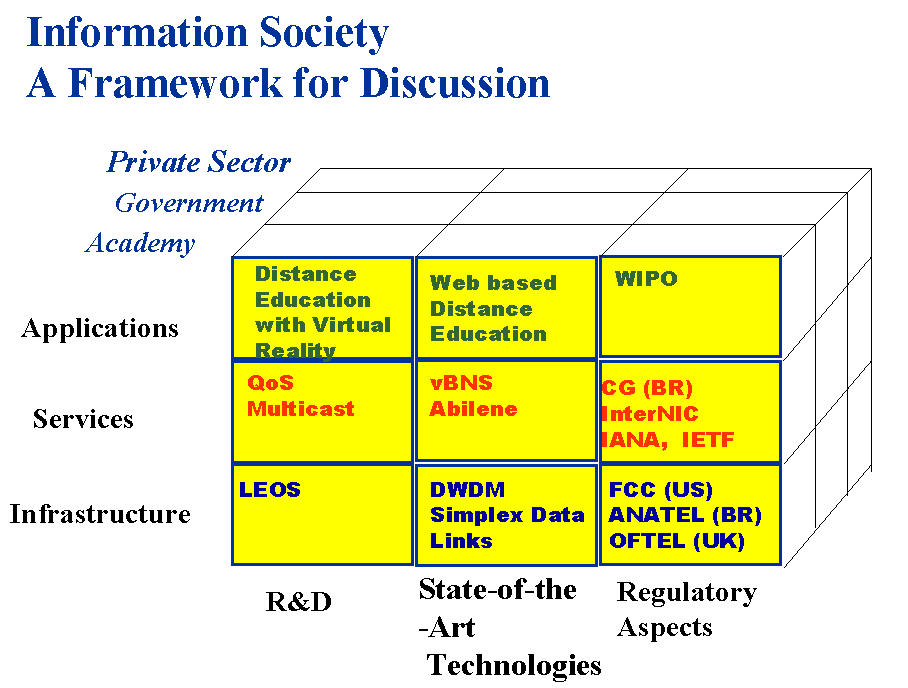
We suggest that the context for the discussion is encompassed by the
3x3x3 matrix below, in which one sees the cartesian product of the three-layered
vision (infrastructure, services, applications) with the way the European
Union has organized its discourse and pilot projects regarding the Information
Society (Research and Development, Use of State-of-the-Art Technologies,
Regulatory Aspects). It becomes fairly apparent, from the matrix, that
the discussion was, for a time, exceedingly concentrated in regulatory
aspects of infrastructure, the realm of organizations such as the FCC and
OFTEL.
The second aspect of a somewhat more refined discourse is that, in developing countries, a shortcut can be found by dissociating the provision of Internet tools and services from telecommunications. One can start the journey towards the information society at the services level, as opposed to starting at the infrastructure level, often strongly regulated, if not subject to monopoly. Most constitutions support that information must circulate freely and its flow cannot be subject to monopoly, and by equating Internet services to what they boil down to, that is, to convey information, one can punch a timely hole in sometimes entrenched telecommunications establishments and grow from there, without having to question the whole legal framework of the internal telecommunications market.
Furthermore, the academic community in universities, technical schools and research centers can be powerful allies in this endeavor. In most developing countries, the Internet "culture" was established in schools and universities, before being absorbed by the commercial sector, and it is that very community that is more well equipped to study, teach and deploy new technologies, for they have been familiar with Unix-based tools, IP routers and Internet protocols for a much longer time than their telecommunications peers. A strategic partnership between the private sector and the research and education community in order to build the beachheads of the information society in developing countries might well be an old idea whose time has come.
 Last, a few candid words
about competition, free trade and other lies. If one looks, for example,
at the evolution of the Brazilian trade balance in recent years, as shown
below, it is obvious, even to the most galloping neoliberal, that the country
is dead serious about opening its borders to foreign goods and services,
having evolved from a scenario of comfortable surplus to a deficit of US$
6.5 billion in 1998. Notice that exports have also increased during the
period, so the deficit cannot be blamed on lack of competitiveness.
Last, a few candid words
about competition, free trade and other lies. If one looks, for example,
at the evolution of the Brazilian trade balance in recent years, as shown
below, it is obvious, even to the most galloping neoliberal, that the country
is dead serious about opening its borders to foreign goods and services,
having evolved from a scenario of comfortable surplus to a deficit of US$
6.5 billion in 1998. Notice that exports have also increased during the
period, so the deficit cannot be blamed on lack of competitiveness.
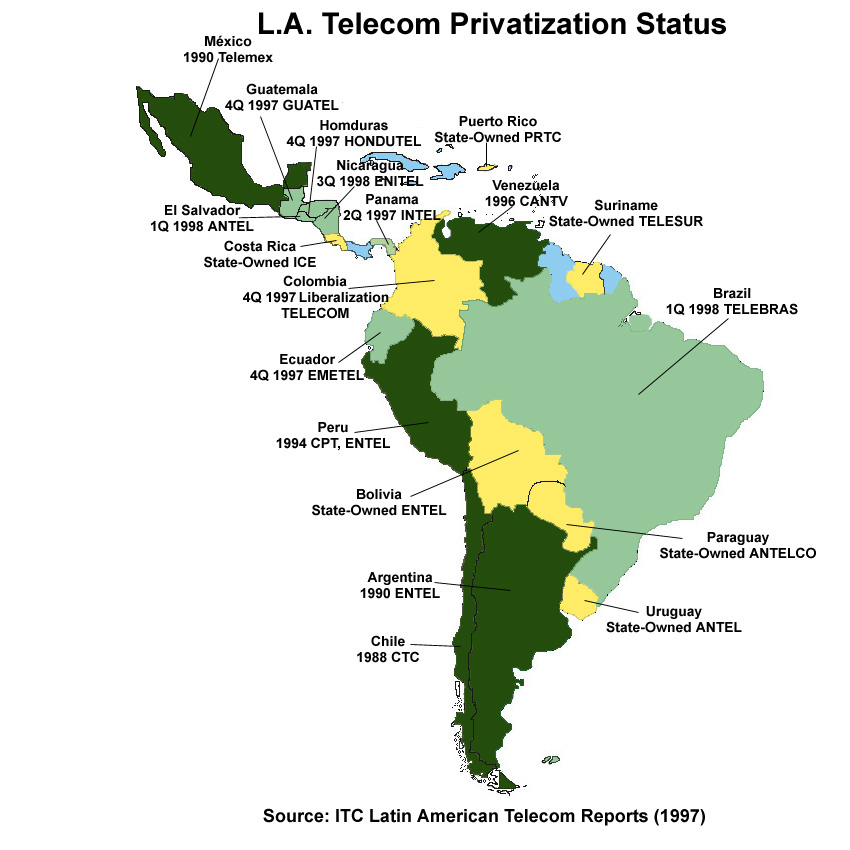
Besides that, as shown in the map below, most of Latin America has either deregulated, privatized or is in the process of privatizing its telecommunications establishment, at a rate and depth that should be observed more appreciatively by the industrialized nations.
On the other hand, the table below depicts the domestic market share
of digital switching equipment in countries that have subscribed to the
Information Technology Agreement (ITA) i.e., frank advocates of competition
and free trade regarding information technology goods and services. There
is no better argument than hard data, and the table below shows not only
that they are in no position to patronizingly lecture developing countries
about competition and free trade, but also that there must be some sort
of non-tariff protection of those internal markets, for the import taxes
in these countries are quite low.

The conclusion is inescapable: with regards to opening information technology
markets in industrialized nations to competition, after all is said and
done we see that more has been said than done.
Dr. Ivan Moura Campos
ivanmc@akwan.com.br
Dra. Regina Helena Bastos Cabral
DCC- UFMG - Brazil
Tel.: +(55)(31)499-4202
Fax: +(55)(31)441-1925
E-mail: reginah@dcc.ufmg.br