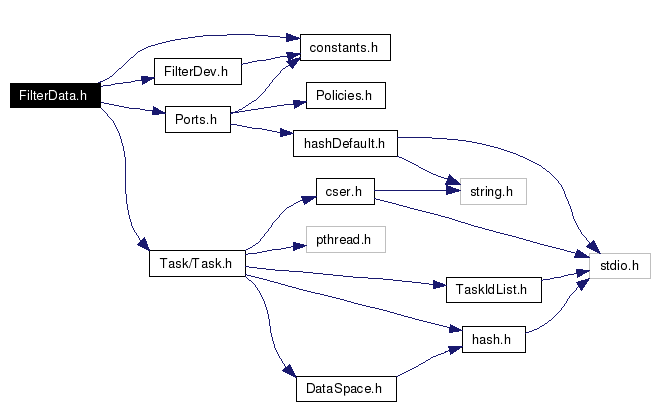
#include "FilterDev.h"#include <Task/Task.h>#include "Ports.h"#include "constants.h"Include dependency graph for FilterData.h:
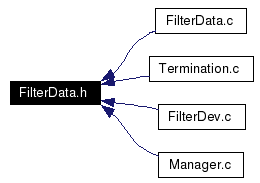
This graph shows which files directly or indirectly include this file:
Go to the source code of this file.
Data Structures | |
| struct | _LibData_ |
| the information about the library of the filter More... | |
| struct | __FilterData__ |
| the data that filter needs to run More... | |
Typedefs | |
| typedef _LibData_ | LibData |
| the information about the library of the filter | |
| typedef __FilterData__ | FilterData |
| the data that filter needs to run | |
Functions | |
| FilterData * | createFilterData () |
| constructor | |
| void | destroyFilterData (FilterData *fd) |
| destroyer | |
| int | recvFilterData () |
| when the filter runs this, hell receive all data he needs to run the pipeline | |
| void | runFilter () |
| runs the filter | |
| int | setFDName (FilterData *fd, char *name) |
| Sets the name of filter. | |
| int | setFDHostName (FilterData *fd, char *hostName) |
| Sets the name of the machine where the filter is runnig. | |
| int | setFDNumInputs (FilterData *fd, int numInp) |
| Sets the number of inputs of the filter. | |
| int | setFDNumOutputs (FilterData *fd, int numOut) |
| Sets the number of output. | |
| int | setFDLibName (FilterData *fd, char *libName) |
| Sets the libname of the filter: Used to load the filter. | |
| int | setFDMachineMem (FilterData *fd, int mem) |
| sets the machine memory declared inside the XML file | |
| int | setFDLocalInstances (FilterData *fd, int numLocalInst) |
| sets the number of instances this filter has in current machine | |
| int | setFDNumInstances (FilterData *fd, int numInstances) |
| Sets the number of instances of this type of filter. | |
| void | setFDRank (FilterData *fd, int rank) |
| Sets the rank of this instance in his set of filters. | |
| void | setFDIdFilter (FilterData *fd, int id) |
| Sets the id of this filter - unique for all filters. | |
| void | setFDTids (FilterData *fd, int *tids) |
| sets the tids of this filter, mine and brothers | |
| int | getFDMachineMem (FilterData *fd) |
| Gets the ammount of memory the machine this filter runs on has. | |
| int | getFDLocalInstances (FilterData *fd) |
| get the number of brothers I have in this same machine | |
| char * | getFDName (FilterData *fd) |
| Gets the name of filter. | |
| int | getFDNumInstances (FilterData *fd) |
| Gets the number of instances of this type of filter. | |
| int | addFDInputPort (FilterData *fd, InputPort *p) |
| adds another inputPort to filteData: we only point to InputPort received -- dont free it | |
| int | addFDOutputPort (FilterData *fd, OutputPort *p) |
| adds another OutputPort to filteData: we only point to OutputPort received -- dont free it | |
| int | loadFDLibFunctions (FilterData *fd) |
| this function loads the filter libraries(init process finalize) | |
Variables | |
| FilterData * | fd |
| Global variable that points to data of filter. | |
|
|
the data that filter needs to run
|
|
|
the information about the library of the filter
|
|
||||||||||||
|
adds another inputPort to filteData: we only point to InputPort received -- dont free it
Definition at line 202 of file FilterData.c. References __FilterData__::inputPorts, MAXINPSTREAMS, and __FilterData__::numInportsAdded. |
|
||||||||||||
|
adds another OutputPort to filteData: we only point to OutputPort received -- dont free it
Definition at line 214 of file FilterData.c. References MAXOUTSTREAMS, __FilterData__::numOutportsAdded, and __FilterData__::outputPorts. Referenced by recvFilterData(). |
|
|
constructor
Definition at line 51 of file FilterData.c. References instCreate(), MAX_HNAME_LENGTH, __FilterData__::numInportsAdded, __FilterData__::numInputPorts, __FilterData__::numOutportsAdded, __FilterData__::numOutputPorts, and trcCreateData(). Referenced by runFilter(). Here is the call graph for this function: 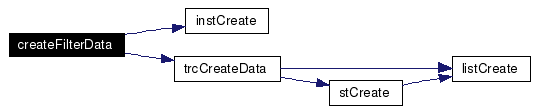 |
|
|
destroyer
Definition at line 82 of file FilterData.c. References destroyInputPort(), __FilterData__::inputPorts, __FilterData__::libdata, _LibData_::libHandler, and __FilterData__::numInputPorts. Here is the call graph for this function:  |
|
|
get the number of brothers I have in this same machine
Definition at line 317 of file FilterData.c. References __FilterData__::numLocalInstances. Referenced by dsGetLocalInstances(). |
|
|
Gets the ammount of memory the machine this filter runs on has.
Definition at line 308 of file FilterData.c. References __FilterData__::memory. Referenced by dsGetMachineMemory(). |
|
|
Gets the name of filter.
Definition at line 132 of file FilterData.c. References __FilterData__::name. |
|
|
Gets the number of instances of this type of filter.
Definition at line 168 of file FilterData.c. References __FilterData__::numInstances. |
|
|
this function loads the filter libraries(init process finalize)
Definition at line 241 of file FilterData.c. References error, _LibData_::finalize, _LibData_::init, __FilterData__::libdata, _LibData_::libHandler, _LibData_::name, and _LibData_::process. Referenced by recvFilterData(). |
|
|
when the filter runs this, hell receive all data he needs to run the pipeline
|
|
|
runs the filter
Definition at line 563 of file FilterData.c. References createFilterData(), initTerminationDetection(), __FilterData__::inputPorts, __FilterData__::numInputPorts, __FilterData__::numOutputPorts, __FilterData__::outputPorts, recvFilterData(), resetInputPort(), resetOutputPort(), and tdd. Referenced by initDs(). Here is the call graph for this function: 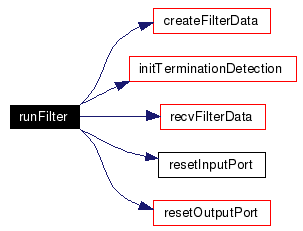 |
|
||||||||||||
|
Sets the name of the machine where the filter is runnig.
Definition at line 153 of file FilterData.c. References __FilterData__::hostName, and MAX_HNAME_LENGTH. Referenced by recvFilterData(). |
|
||||||||||||
|
Sets the id of this filter - unique for all filters.
Definition at line 185 of file FilterData.c. References __FilterData__::id. Referenced by recvFilterData(). |
|
||||||||||||
|
Sets the libname of the filter: Used to load the filter.
Definition at line 225 of file FilterData.c. References __FilterData__::libdata, MAX_LNAME_LENGTH, and _LibData_::name. Referenced by recvFilterData(). |
|
||||||||||||
|
sets the number of instances this filter has in current machine
|
|
||||||||||||
|
sets the machine memory declared inside the XML file
Definition at line 295 of file FilterData.c. References __FilterData__::memory. Referenced by recvFilterData(). |
|
||||||||||||
|
Sets the name of filter.
Definition at line 137 of file FilterData.c. References MAX_FNAME_LENGTH, and __FilterData__::name. Referenced by recvFilterData(). |
|
||||||||||||
|
Sets the number of inputs of the filter.
Definition at line 118 of file FilterData.c. References MAXINPSTREAMS, and __FilterData__::numInputPorts. Referenced by recvFilterData(). |
|
||||||||||||
|
Sets the number of instances of this type of filter.
Definition at line 172 of file FilterData.c. References MAXINSTANCES, and __FilterData__::numInstances. Referenced by recvFilterData(). |
|
||||||||||||
|
Sets the number of output.
Definition at line 126 of file FilterData.c. References __FilterData__::numOutputPorts. Referenced by recvFilterData(). |
|
||||||||||||
|
Sets the rank of this instance in his set of filters.
Definition at line 180 of file FilterData.c. References __FilterData__::myRank. Referenced by recvFilterData(). |
|
||||||||||||
|
sets the tids of this filter, mine and brothers
Definition at line 190 of file FilterData.c. References __FilterData__::numInstances, and __FilterData__::tids. Referenced by recvFilterData(). |
|
 1.4.6
1.4.6